
What Would Earth Feel Like Without a Permanent Sense of Up and Down?
Astronauts lose their sense of up within hours of reaching orbit. What they experience reveals how much quiet work our bodies do to keep the world upright.
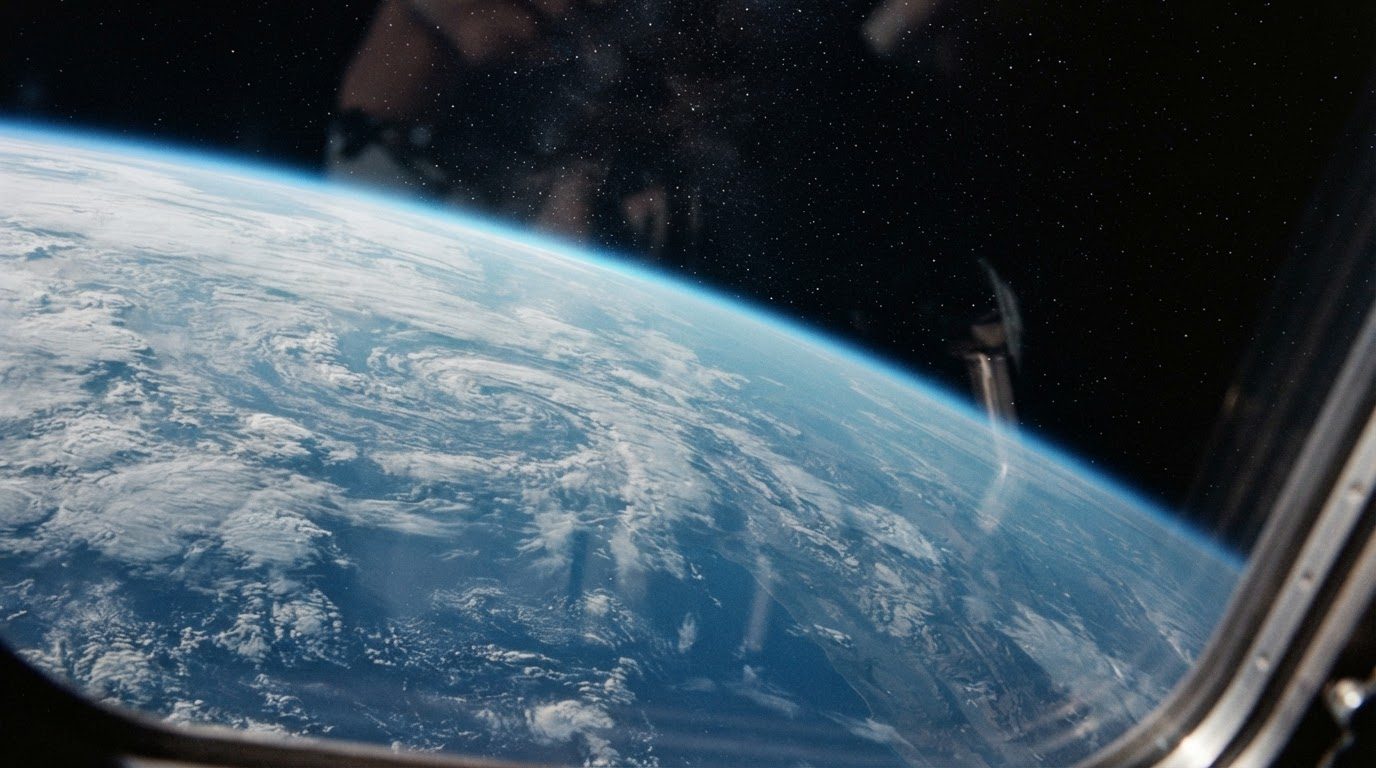
You never have to think about which way is up. It is simply given, as obvious as the floor under your feet. You can close your eyes, lie in a dark room or float in a swimming pool, and still you know where down is. That certainty feels like a fact about the world. It is actually a sensation, produced continuously and silently by a small structure deep inside your head.
We usually list five senses, but the list leaves out several that we depend on every moment. One of the most important is the vestibular sense, the sense of balance, motion and orientation. Its organs sit in the inner ear, embedded in the bone of the skull on each side, alongside the spiral-shaped structure used for hearing. They are about the size of a pea, and without them the simple act of standing up would become a constant struggle.
The vestibular system has two parts that do different jobs. The first is a set of three semicircular canals, curved tubes filled with fluid and arranged roughly at right angles to one another, like the corner of a box. When your head turns, the fluid lags slightly behind because of its inertia, bending tiny hair cells at the base of each canal. Because the three canals face different directions, together they can detect rotation in any direction: nodding, shaking or tilting the head.
The second part detects gravity and straight-line movement. Two small chambers, called the utricle and the saccule, contain sensory hair cells covered by a jelly-like layer. On top of that layer sit tiny crystals of calcium carbonate called otoconia, literally ear stones. The crystals are heavier than the jelly, so when you tilt your head, gravity pulls them and bends the hair cells beneath. The pattern of bending tells the brain which way is down. When you accelerate in a car or a lift, the crystals lag behind in the same way, which is why you feel acceleration even with your eyes closed.
The brain does not rely on the inner ear alone. It combines vestibular signals with vision and with information from receptors in the muscles, joints and skin, particularly the pressure on the soles of the feet. Normally these sources agree, and the result is a single, stable sense of orientation. But when they disagree, things go wrong. Reading in the back of a moving car is a classic example: your eyes report that you are still, while your inner ear reports motion. One influential explanation of motion sickness is that this conflict between the senses is what makes people feel ill.
Up is not something we see. It is something the body tells us, constantly and quietly.
Now imagine what happens when gravity effectively disappears. Astronauts in orbit are not beyond the reach of Earth's gravity; at the height of the International Space Station it is still about ninety per cent as strong as on the ground. But the station and everyone in it are in continuous free fall around the planet, and in free fall everything falls together. The otoconia no longer press down on the hair cells. The inner ear stops reporting a direction for down.
The first days in orbit can be difficult. Many astronauts experience space motion sickness, with nausea, headaches and disorientation, most likely because their eyes, bodies and inner ears are now sending incompatible information. Turning the head quickly can be particularly unpleasant. Over several days the brain adapts, relying more on vision and on touch, and less on the silent inner ear.
Astronauts describe how up becomes a matter of choice. Inside a module, the ceiling can become the floor simply by deciding that it is, and some report sudden visual reorientation, in which the whole cabin seems to flip around them when they change their mental frame of reference. Designers of spacecraft interiors have learned to help by giving each module a clear visual up: lights on one surface, equipment arranged as it would be on the ground. Without gravity, orientation becomes something the mind constructs from what the eyes can see.
Returning to Earth reverses the process. After weeks or months in orbit, astronauts often find walking unsteady, and tilting the head can feel as though the room is tipping. The brain has recalibrated to weightlessness and must relearn gravity. Recovery usually takes days to weeks, and it offers a vivid reminder that our ordinary sense of stability is a skill the brain maintains, not a fixed property of the body.
Here on the ground, people with damage to the vestibular system can experience something similar without ever leaving the planet. Conditions affecting the inner ear can cause vertigo, the sensation that the world is spinning or tilting when it is not. One of the most common, benign paroxysmal positional vertigo, occurs when some of the tiny otoconia become dislodged and drift into one of the semicircular canals, where they interfere with the detection of rotation. Simple head movements performed by a clinician can often move the crystals back where they belong, a striking example of how a problem measured in fractions of a millimetre can upend a person's whole sense of the world.
What would Earth feel like without a permanent sense of up and down? We can only partly imagine it. There would be no floor that is always a floor, no sky that is always above. Direction would become something you decide rather than something you feel. Many creatures do live closer to this state than we do: animals in the deep ocean, or birds in flight, move through space in all three dimensions with far less reliance on a fixed ground.
For human beings, though, the sense of up is one of the most basic ways we inhabit the planet. It shapes our architecture and our language: we rise and fall, feel low or high, look up to people and fall behind. It is present in almost every moment of our lives and almost entirely unnoticed. We only become aware of it when it disappears, when we step off a spinning ride, feel a boat move beneath us or watch an astronaut drift through a cabin where the ceiling is suddenly the floor.
So the next time you stand up without thinking, notice what has happened. A few crystals of calcium carbonate, resting on a bed of jelly inside your skull, have felt the pull of the entire Earth, and told you where it is.