
The Whale Knows a World We Cannot Enter
What happens when an animal spends its entire life inside a medium that carries sound, pressure and movement through its body?
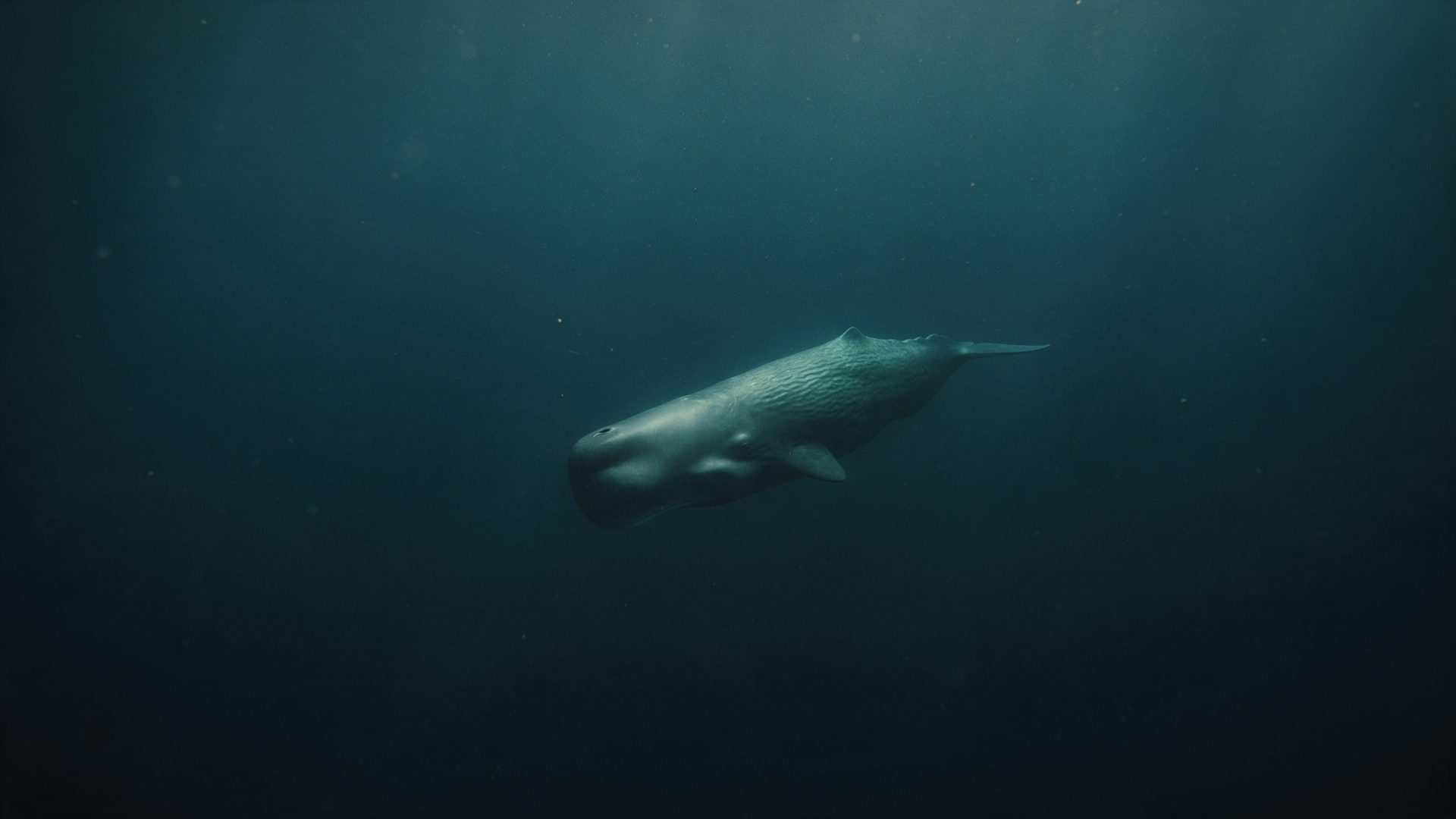
There is something deeply strange about a whale, and it has very little to do with its size. The real mystery is the possibility that a whale may experience Earth in a way that is almost impossible for the human mind to imagine. We share the same planet, but that does not mean we inhabit the same perceptual world.
When humans look at the ocean, we usually see a surface. We see waves, depth, colour, darkness and distance, but we still understand water as something separate from ourselves. We enter it, swim through it, float on it and eventually return to land, while the whale never makes that separation because the liquid is the environment in which its entire body, movement and perception were shaped.
The ocean does not merely surround the whale. It carries its body, presses against its skin, changes temperature around it, transmits vibration and transports the voices of other animals across distances that vision cannot reach. The whale therefore does not simply move through water in the way a human walks through a room, because the medium itself is continuously participating in what the whale can sense.
Human life is built around gravity and surfaces. We stand, sit, fall, climb and walk, and nearly everything we build assumes that there will be something solid beneath us. Even our language carries this architecture, because we speak of rising, falling, reaching the top, hitting the bottom and remaining grounded as though a floor were one of the basic conditions of existence.
A whale lives in a world where the floor may be kilometres away. It can move forward, backward, upward, downward and diagonally through open space without needing to touch a surface at all. Three-dimensional movement is not an unusual experience for the whale but the ordinary geometry of life.
That alone may produce a very different internal map of reality. A whale can descend into deep water, rotate its enormous body, travel through darkness and rise again without any fixed reference beneath it. Above may be sunlight, below may be kilometres of black water, and all around may be open space filled with currents, sound and pressure.
There is another difference that may be even more profound. Humans experience much of the world through specialised sensory organs concentrated in particular places, such as the eyes, ears, nose and hands. A whale, however, lives inside a substance that is already touching nearly its entire body at every moment, which means that movement in the environment is continuously interacting with the animal itself.
Water passes over the skin, currents push against the body, pressure changes with depth and vibrations move through the surrounding medium. The ocean is not scenery sitting at a distance from the whale, because it is in constant physical contact with it. This creates the intriguing possibility that the boundary between body and environment may feel different in a creature whose entire existence takes place inside a dense, moving liquid.
Humans often experience reality as something outside ourselves. There is the self, contained by the skin, and then there is the world beyond it. But if the environment continuously supports your weight, presses against your body and carries information toward you from every direction, perhaps the distinction between where the body ends and where the environment begins becomes less psychologically obvious.
Then there is sound, which changes the entire character of the underwater world. Sound travels much faster through water than through air and, under favourable conditions, can travel across enormous distances. For whales, sound is therefore not simply something that happens inside the environment, because it can become one of the main ways the environment itself is revealed.
Toothed whales such as dolphins and sperm whales can use echolocation. They produce clicks that travel through water, strike objects and return as echoes containing information about distance, direction, movement and shape. Humans can understand this process scientifically, but understanding how echolocation works is not the same as knowing what it feels like to experience space through returning sound.
That distinction matters because human beings are overwhelmingly visual. We tend to think of seeing as the most direct way of knowing what is around us, and our language reflects this when we say that we “see” a point or gain “insight” into something. A whale adapted to darkness and sound may organise reality through sensory priorities that are profoundly different from ours.
Distance may also feel different in such a world. For humans, someone kilometres away has usually disappeared from our immediate sensory experience unless technology reconnects us. For a whale, another animal may move far beyond visual range and still remain present through sound travelling across the water.
This means that a whale's social world may extend beyond what it can physically see. Voices can arrive from darkness, from depth and from distances that would make ordinary human conversation impossible. Presence itself may therefore be less tightly connected to sight and physical closeness than it is for us.
Darkness provides another clue to how different that world may be. Humans lose an enormous amount of useful information when light disappears, because vision dominates so much of our perception. Whales can enter places where sunlight is weak or absent, yet the disappearance of light does not necessarily mean the disappearance of the surrounding world.
This raises a broader question about perception itself. Human beings often confuse the portion of reality available to our senses with reality as a whole. We see only a narrow range of electromagnetic radiation, hear only a limited range of frequencies and lack many sensory abilities that other animals use routinely.
Biologists and philosophers sometimes use the term Umwelt to describe the perceptual world available to a particular organism. A bee can detect ultraviolet patterns on flowers that humans cannot see, dogs inhabit landscapes filled with chemical information that we barely notice, and many animals respond to environmental signals that never enter ordinary human awareness. The whale's Umwelt may be an enormous liquid, acoustic and three-dimensional world that overlaps physically with ours while remaining experientially very different.
This means that the same physical planet can contain multiple lived realities at once. A human and a whale may occupy nearly the same location while receiving very different kinds of information from it. They share matter, gravity, sunlight and water, but the worlds constructed by their nervous systems do not have to resemble one another.
The ocean makes this especially interesting because it does more than provide a location for the whale. Its density supports a body that would struggle under its own mass on land, its pressure changes physiology with depth, its currents shape movement and its acoustic properties allow information to travel through darkness. The whale is not simply navigating the ocean but living inside a physical system that continuously participates in its perception.
Perhaps this is why imagining whale consciousness eventually reaches a limit. Human beings naturally imagine other minds using the architecture of our own experience, with sight, language, memory, faces, rooms, horizons and familiar notions of distance. Evolution, however, had no obligation to build every mind around the same sensory priorities.
A mind shaped over millions of years in water may organise space, presence, movement and embodiment in ways for which human language has no precise equivalent. Some aspects may still be familiar, such as recognition, attachment, curiosity, learning or play. Others may be as difficult for us to imagine as colour would be to a creature that had never possessed vision.
That possibility changes the meaning of the whale. It is no longer simply a very large animal living beneath the surface, because it becomes evidence that Earth may contain forms of experience that humans can study without ever fully entering. We can measure behaviour, anatomy, sound, migration and neural activity, yet the internal world produced by all of those things may remain partly inaccessible.
Perhaps that is the most interesting lesson. Reality may be much larger than the human experience of it, because every nervous system reveals some things while leaving others hidden. The whale disappears beneath the surface into the same planet we inhabit, but it may enter a version of Earth that feels profoundly different from ours, a world of pressure, depth, vibration, darkness and sound that we can observe from the outside but may never completely know from within.