
Why Vastness Feels Both Comforting and Terrifying
Standing beneath a night sky can make us feel insignificant and strangely at peace at the same time. Psychologists have begun to study why.
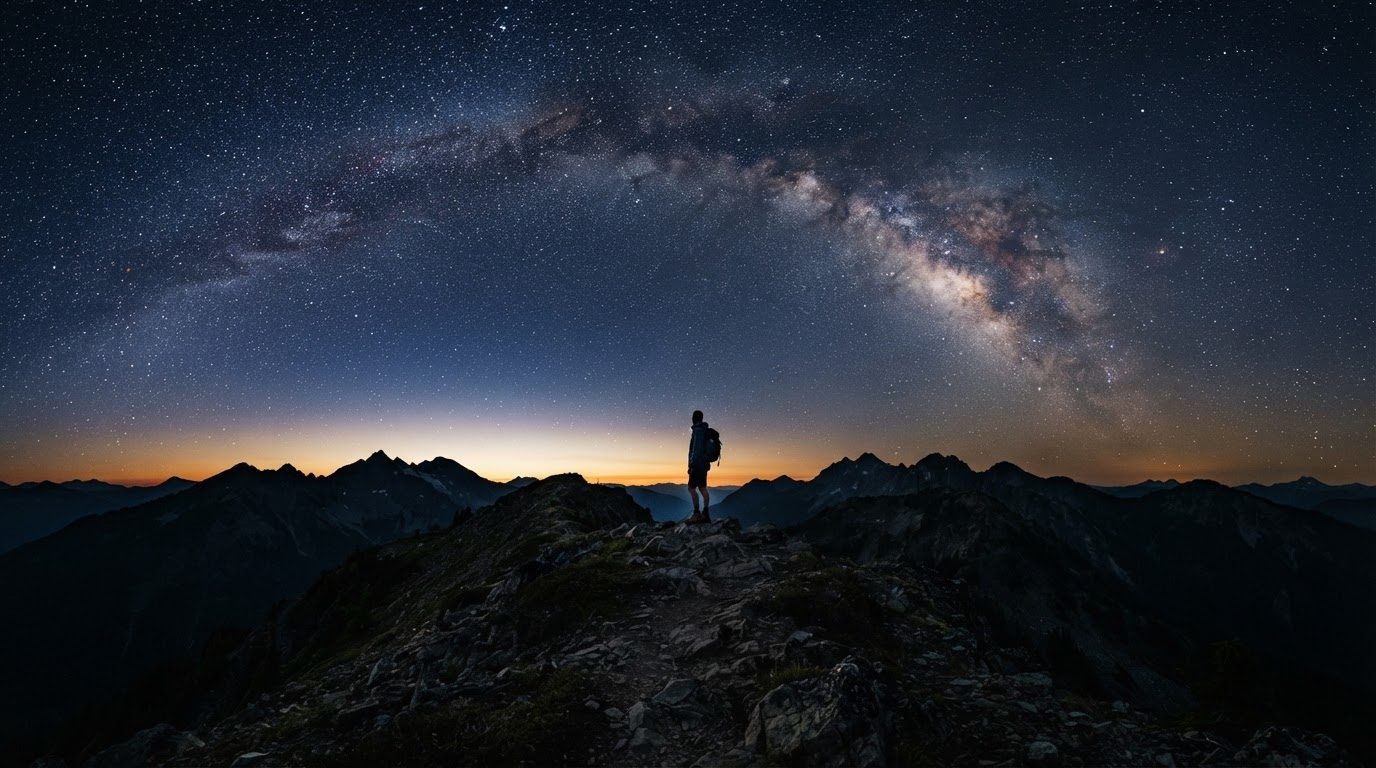
Look up on a clear, dark night, far from city lights, and the Milky Way spreads across the sky like a pale river. Some of the light reaching your eyes left its stars thousands of years ago. The band itself is the glow of a galaxy containing hundreds of billions of suns, seen edge-on from inside. Most people who experience this describe two feelings arriving together: a sense of being tiny, even insignificant, and a quiet, almost relieving calm. It is a strange combination. Why should feeling small feel good?
The feeling has a name. Psychologists call it awe, and for a long time it received surprisingly little scientific attention. That began to change in 2003, when Dacher Keltner and Jonathan Haidt published an influential paper describing awe as a response to two things together. The first is vastness: something much larger than the self, whether physically, like a canyon or a storm, or conceptually, like a grand idea or an extraordinary act of skill. The second is what they called a need for accommodation: the experience does not fit into our existing understanding, and the mind has to stretch to hold it.
That second part matters. Plenty of things are large without being awe-inspiring. A car park can be vast. Awe arrives when size or complexity exceeds our categories, when we are confronted with something we cannot easily explain or contain. The night sky does this for most people. So does the ocean, a thunderstorm, a newborn child, a mathematical proof or a piece of music that seems to open a door. The common thread is the sense of encountering something bigger than our current picture of the world.
One of the most consistent findings in awe research is what psychologists call the small self. People who experience awe tend to describe themselves as smaller and less central. Asked to draw themselves, they draw smaller figures. In a study led by Paul Piff in 2015, participants who spent a single minute looking up at a grove of towering eucalyptus trees were afterwards more helpful to a stranger who dropped a handful of pens than participants who spent the same minute looking up at a tall building. Other studies have linked awe with greater generosity, a stronger sense of connection to others and a reduced focus on personal concerns.
Awe does not make us matter less. It makes our worries matter less.
That may explain the comfort. When the self becomes smaller, so do its anxieties. Problems that filled the whole view a moment earlier, the unanswered message, the awkward conversation, the deadline, are placed back in proportion against something immeasurably larger. Awe does not solve those problems. It changes their scale. Some neuroscientists have suggested that awe may quieten brain networks involved in self-focused thought, though this research is still at an early stage.
Astronauts describe an extreme version of the experience. Many who have seen Earth from orbit report a profound shift in perspective, sometimes lasting for years: an overwhelming sense of the planet's fragility and unity, of borders disappearing and of humanity as a single, vulnerable community. The writer Frank White called this the overview effect. Not every astronaut experiences it, and descriptions vary, but the pattern is striking. Seeing the whole of the human world as a small blue sphere against black space seems to reorganise what feels important.
Yet awe has a darker edge. Vastness can also feel threatening. The eighteenth-century philosopher Edmund Burke distinguished the beautiful, which is pleasing and harmonious, from the sublime, which he associated with a kind of delightful terror: the thrill of encountering something powerful, immense or dangerous from a position of relative safety. A storm at sea is sublime when watched from the shore and simply terrifying when you are in the boat. Immanuel Kant later argued that the sublime reveals both our physical smallness and the power of a mind that can nevertheless contemplate infinity.
Some people feel the dread more than the wonder. The seventeenth-century mathematician and philosopher Blaise Pascal wrote of being frightened by "the eternal silence of these infinite spaces." For him the vastness of the universe raised the question of what, if anything, a single human life could mean within it. Researchers now describe a spectrum of awe, from positive wonder to threat-based awe, depending on whether the vastness seems safe or dangerous, benign or indifferent.
What determines which way the feeling tips? Context plays a part, as does personal outlook. For some, a sense that the universe is ordered and intelligible turns vastness into beauty: the stars are awe-inspiring because they obey laws that a human mind can understand. For others, the same vastness underlines how brief and fragile a single life is. Both reactions are reasonable. Both are responses to something true.
It is worth noticing, too, that most people alive today rarely see a truly dark sky at all. Studies of artificial light at night estimate that more than a third of humanity, and the great majority of people in Europe and North America, can no longer see the Milky Way from where they live. An experience that every human generation before the last century took for granted has become rare. We may have lost a regular source of awe without quite realising it.
There is a final reason why the night sky might be both humbling and consoling, and it lies in what science has discovered about our origins. The heavier atoms in your body, the carbon in your cells, the calcium in your bones and the iron in your blood, were forged inside stars and scattered across space when those stars died, long before the Sun formed. When you look up at the stars, you are looking at the same kind of process that made the material you are made of.
We live on a small planet orbiting an ordinary star in one galaxy among a vast number of others. That is humbling. But it is also extraordinary that a creature this small can know it at all: that matter which came from stars has become capable of looking back at them and wondering what they are.
Perhaps that is why vastness feels both comforting and terrifying. It shows us how little we are, and in the same moment reveals how remarkable it is to be here, small and brief, able to feel the scale of it all.