
When the Sky Can No Longer Hold the Charge
Before a lightning bolt, a cloud spends minutes quietly building a difference so large that the air itself gives way.
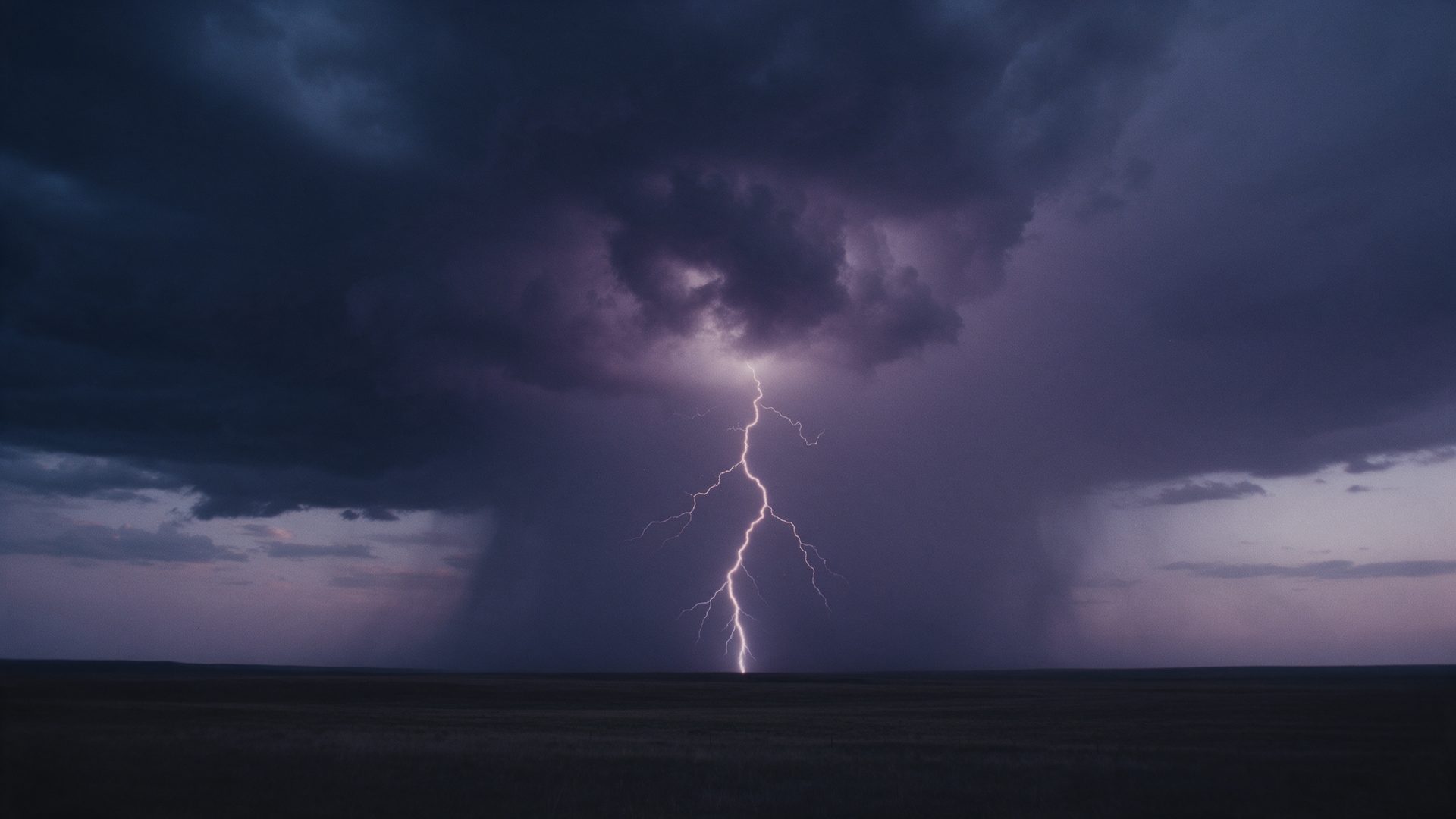
Lightning begins long before the sky flashes. What we eventually see as a brilliant branch of light is only the visible end of a process that has been building quietly inside a storm. Before the flash appears, the cloud has already spent minutes, sometimes longer, moving water, ice, air and electrical charge into an unstable arrangement.
A thunderstorm may look almost still from the ground, but inside it is intensely active. Warm, moist air rises rapidly, cooler air sinks, droplets form, ice crystals grow, and pieces of soft hail known as graupel move through powerful updrafts and downdrafts. The cloud becomes less like a passive object floating in the sky and more like a vast atmospheric machine.
As ice crystals and graupel collide, electrical charge can be transferred between them. Under common thunderstorm conditions, lighter ice crystals tend to become positively charged while heavier graupel tends to acquire negative charge. Because the lighter crystals are carried upward more easily, the storm gradually separates those charges across different parts of the cloud.
The upper region of the cloud often becomes predominantly positive while a large region lower down becomes predominantly negative. This separation creates an increasingly strong electric field between different parts of the storm and between the cloud and the ground below. Nothing has flashed yet, but the cloud has already built an invisible electrical structure stretching across kilometres of atmosphere.
Normally, air is an excellent electrical insulator. Its molecules do not easily allow large numbers of electrons to move freely through them, which is one reason electricity does not constantly leap across open space around us. As the electric field inside a storm becomes stronger, however, the air begins approaching the limit of how much electrical stress it can withstand.
Once that limit is exceeded in particular regions, the air begins to ionise. Electrons are torn away from molecules, producing charged particles that make the air more conductive than it was before. A region that had previously resisted electrical current can now begin forming a pathway through which charge may travel.
In many cloud-to-ground strikes, a faint electrical channel called a stepped leader begins moving downward from the negatively charged region of the cloud. It does not travel in one smooth line, because the atmosphere beneath it is not electrically uniform. Instead, it advances in rapid steps, repeatedly branching as it searches for regions where the next stage of electrical breakdown can occur.
This branching movement is one reason lightning has its familiar tree-like shape. Temperature, humidity, particles and local electric fields vary throughout the air, so the path does not simply follow a perfect straight line toward the Earth. Every branch represents the electrical discharge exploring a different possible route through the atmosphere.
While the leader is descending, the ground beneath the storm is changing electrically as well. The negative charge concentrated in the lower cloud repels electrons near the surface, leaving parts of the ground relatively positively charged. That positive charge can become especially concentrated around tall or pointed objects such as trees, towers, rooftops, ridges and poles.
As the descending leader gets closer, upward-moving electrical channels called streamers can begin rising from those objects. The cloud is extending an electrical pathway downward while the ground begins extending possible pathways upward. Eventually, one of those upward streamers connects with the descending leader and completes a conductive channel between the cloud and the Earth.
At that moment, the electrical imbalance finally has a continuous route through which it can discharge. A powerful current surges along the newly formed channel in what is called the return stroke. This is the intensely bright part of the event that we normally recognise as lightning.
The current heats the surrounding air extremely quickly, reaching temperatures of roughly 30,000 degrees Celsius. That is several times hotter than the visible surface of the Sun. For a fraction of a second, ordinary atmospheric gas becomes intensely ionised and glows as enormous electrical energy passes through it.
This extreme heating also creates thunder. The air around the lightning channel expands almost explosively because of the sudden temperature increase, producing a pressure wave that travels outward through the atmosphere. What we hear as thunder is therefore the atmosphere physically reacting to the heat produced by the lightning discharge.
The flash reaches us long before the sound because light travels vastly faster than sound through air. Lightning and thunder are produced nearly together, but the light arrives at our eyes almost immediately while the pressure wave takes much longer to cross the same distance. This is why the delay between the flash and the thunder can give a rough indication of how far away the lightning occurred.
What appears to be a single flash can also contain several separate electrical pulses. Once a channel has formed, additional current can travel through it again in rapid succession, causing the bolt to flicker. Human vision may blend those extremely fast events into what seems like one continuous flash.
Cloud-to-ground lightning is only one part of the phenomenon. Much of the world's lightning occurs entirely within clouds, where different regions of charge discharge into one another. Lightning can also move between clouds or from clouds into the surrounding atmosphere, illuminating huge sections of a storm without ever touching the surface.
Some thunderstorms even produce strange electrical events high above the cloud tops. Sprites can appear as enormous reddish flashes in the upper atmosphere, while blue jets and other transient luminous events can extend upward from storms toward regions far above ordinary weather. A thunderstorm can therefore connect electrical processes near the ground with processes occurring close to the edge of space.
What makes lightning especially fascinating is that almost everything important happens before we see anything. Charge separation is invisible, electric fields are invisible, and the gradual ionisation of air is usually invisible from the ground. The bright bolt appears only when this hidden electrical architecture finally becomes conductive enough to reveal itself.
In that sense, lightning does not create the electrical tension inside the storm. It exposes the route through which that tension finally collapsed. The branching bolt is almost like a temporary drawing of invisible forces that had already been organised across the sky.
This is also why lightning can look chaotic while still being completely governed by physics. The path changes because the atmosphere itself is uneven, and each part of the discharge responds to the conditions immediately around it. What looks random from a distance is actually the result of countless local interactions occurring too quickly and at too many scales for the human eye to follow.
A thunderstorm can continue repeating this process because the machinery inside the cloud does not stop after one strike. Air continues rising and falling, ice keeps colliding, charge continues separating, and the electrical imbalance begins rebuilding. One flash may temporarily reduce the difference, but the storm can create it again.
Lightning is therefore not simply electricity falling out of the sky. It is what happens when an atmosphere that has been separating charge can no longer keep that separation intact. For one brilliant moment, the air changes from barrier to pathway and the sky becomes part of an electrical circuit.
Perhaps that is why lightning feels so dramatic even when we understand the science behind it. We are watching an invisible force become visible through matter. The cloud has spent time quietly building a difference, and lightning is the instant when that difference becomes too great to remain hidden.