
How Does Sound Create a World Underwater?
Light fades within a few hundred metres of the ocean's surface. Sound can cross entire ocean basins — and the creatures of the sea have been listening for millions of years.
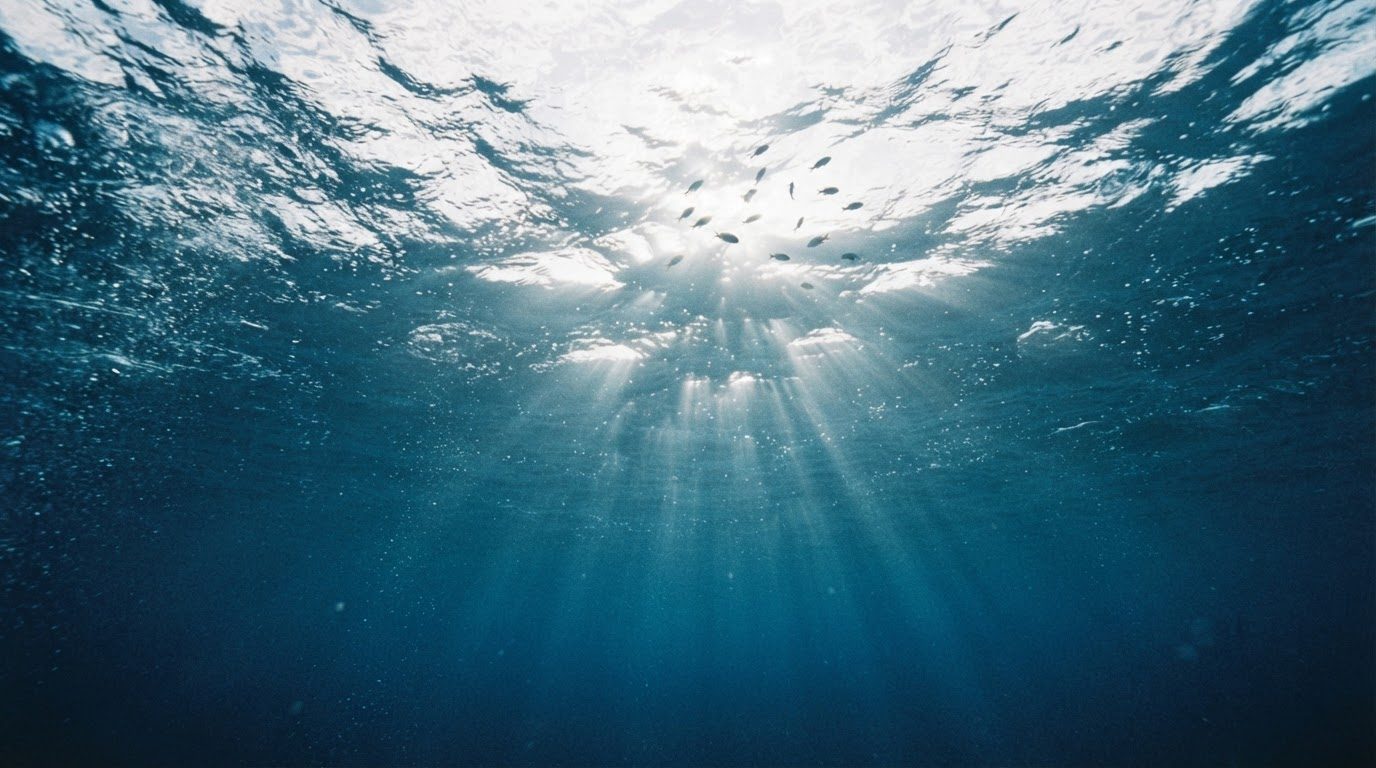
Dive beneath the surface of the sea and the world seems to go quiet. The noise of wind and waves disappears, voices vanish, and all you hear is your own breathing and a muffled hum. It is easy to conclude that the ocean is a silent place. That impression is almost entirely wrong. It is a quirk of human ears, which evolved for air and work poorly underwater. To the animals that live there, the ocean is full of sound: clicks, songs, crackles, grunts, rumbles and the constant roar of the sea itself. Beneath the surface, sound is not a background detail. It is how the world is known.
The reason begins with light. Water absorbs and scatters light far more than air does. Red light fades within the first few metres, which is why underwater photographs turn blue and green. Even in the clearest open ocean, only a small fraction of sunlight remains a couple of hundred metres down, and by a kilometre it is effectively gone. Most of the ocean, by volume, is permanently dark. Vision there is limited to what an animal's own light, or the glow of other creatures, can reveal.
Sound behaves very differently. It travels through seawater at roughly 1,500 metres per second, more than four times faster than through air, and it loses energy far more slowly, especially at low frequencies. A shout in open air fades within a few hundred metres. A low-frequency sound in the ocean can remain detectable across hundreds or even thousands of kilometres. In water, sound is the long-distance sense.
The ocean does not carry sound uniformly, and that is where the story becomes remarkable. The speed of sound in seawater depends on temperature, pressure and salinity. Near the surface the water is warm, so sound travels relatively fast. As you descend, the water cools rapidly and sound slows down. Deeper still, the temperature levels off but the immense pressure keeps rising, and pressure speeds sound up again. Somewhere in between, often around a kilometre down in many parts of the world's oceans, there is a layer where sound travels most slowly.
Sound waves bend towards regions where they travel more slowly, a process called refraction. So a sound produced near this slow layer and heading upward is gently bent back down, and a sound heading downward is bent back up. Instead of spreading out and fading, it becomes trapped, weaving back and forth within a natural channel and carrying energy across enormous distances. Oceanographers call it the SOFAR channel, short for Sound Fixing and Ranging, or simply the deep sound channel.
Its existence was established in the 1940s by the American scientist Maurice Ewing and his colleagues, who showed that a small explosive charge set off in the channel could be heard well over a thousand kilometres away. During the Second World War, the idea was explored as a way of locating downed airmen: a charge detonated at depth could be picked up at listening stations, and the arrival times used to fix its position. In 1991, in an experiment known as the Heard Island Feasibility Test, scientists transmitted low-frequency sounds from the southern Indian Ocean and detected them at receivers as far away as the coasts of North America.
The ocean has a whispering gallery the size of a planet.
For the animals of the sea, sound is woven into almost everything. Toothed whales and dolphins produce rapid clicks and listen for echoes, building detailed pictures of their surroundings and of the prey hidden in them. Baleen whales, such as blue and fin whales, produce extremely low calls that can carry across great distances. Humpback whales sing long, complex songs that change gradually over seasons and spread between populations across ocean basins, one of the most remarkable examples of cultural transmission in the animal world.
Fish are far from silent too. Many species grunt, drum or croak using muscles attached to their swim bladders, especially when courting or defending territory. At certain times of year, choruses of fish can be heard along coastlines. Some of the loudest sounds in shallow seas come from tiny animals: snapping shrimp, which close an oversized claw so fast that they create a collapsing bubble with a sharp crack. In many coastal waters, the collective crackle of countless shrimp forms a constant background noise, a sound like frying fat.
Sound can even guide the youngest animals home. The larvae of many reef fish drift in open water for weeks before settling on a reef. Experiments have found that some larvae appear to swim towards recordings of healthy reef soundscapes, the crackles, pops and calls that a living reef produces. A reef, it seems, can be heard before it can be seen, and a young fish may follow that sound across the dark.
In this world, silence can be a warning. Researchers comparing healthy and damaged reefs have found that degraded reefs are noticeably quieter, with fewer of the sounds that signal life. And the sound of the ocean is changing for another reason. Since the industrial age, human activity has added a great deal of low-frequency noise to the sea. Commercial shipping produces a constant background hum across major routes. Seismic surveys, sonar, construction and drilling add louder bursts. This noise overlaps with the frequencies many whales use to communicate, and studies have found that some whales call louder, change their calls or alter their behaviour in noisy conditions.
For creatures that depend on sound to find food, mates and each other, increasing noise can shrink their world, reducing the distance over which they can hear and be heard. There was a striking demonstration of this in 2001. After the September 11 attacks, shipping traffic in the Bay of Fundy off Canada was briefly reduced, and researchers studying North Atlantic right whales there found that the underwater noise dropped and that stress hormone levels in the whales fell at the same time.
The ocean covers most of the surface of our planet, and much of it has always been a world of sound. Its inhabitants have been listening for millions of years, and their lives are organised around what they hear. We have only recently begun to listen with them, dropping hydrophones into the sea and discovering how loud and structured that world really is.
Perhaps the most important thing to understand about the ocean is not what it looks like but what it sounds like. Beneath the waves, in the dark where light cannot follow, the sea is continuously describing itself. The animals there are fluent in that description. We are only just learning to hear it.