
Where Does Pain Actually Exist?
It feels as if pain is in the hand you burned. But some people feel pain in limbs they no longer have — and that changes what pain turns out to be.
When you stub your toe, the pain is clearly in your toe. It could hardly be anywhere else. The sharp flash, the throbbing afterwards and the urge to grab your foot all point to one place. And yet this simple certainty turns out to be one of the most interesting puzzles in the science of the body and mind. Where does pain actually exist?
The obvious answer is that pain lives in damaged tissue, and that nerves simply carry the news to the brain. For centuries this was more or less the accepted view. In the seventeenth century René Descartes pictured pain as a kind of bell-pull: a fire burns the foot, a fine thread running up the leg is tugged, and a bell rings in the head. It is an intuitive picture. It is also, as it turns out, deeply incomplete.
Scientists now distinguish between two things that everyday language runs together. Nociception is the detection of potentially harmful events by specialised nerve endings called nociceptors. These respond to intense heat, crushing pressure, sharp cuts and certain chemicals released by injured tissue. Their signals travel along nerve fibres to the spinal cord and on to the brain. Pain is something else: the unpleasant experience that may or may not follow. Most of the time the two go together. But they can come apart in both directions.
History is full of accounts of serious injuries that were not felt at the time. The anaesthetist Henry Beecher, who treated wounded soldiers during the Second World War, reported that many men with severe injuries asked for far less pain relief than he expected. Athletes finish matches on broken bones. People escaping danger discover wounds only afterwards. In each case the nociceptive signals were there, but the brain, occupied with something more urgent, did not turn them into pain at that moment.
The reverse also happens. People can feel intense and lasting pain where no ongoing tissue damage can be found. Chronic pain conditions affect a substantial share of the adult population, and in many of them the pain persists long after any original injury has healed. The nervous system itself becomes more sensitive, amplifying signals and even generating pain without any harmful input. The alarm keeps ringing after the fire is out.
The most striking example of all is the phantom limb. A large majority of people who lose an arm or a leg continue to feel it afterwards, and many feel pain in it: cramping, burning, stabbing, or the sense of a fist clenched so tightly that the nails dig into a palm that no longer exists. The pain is felt in a precise location, in a part of the body that is not there. It is hard to imagine a clearer demonstration that pain is not simply stored in tissue.
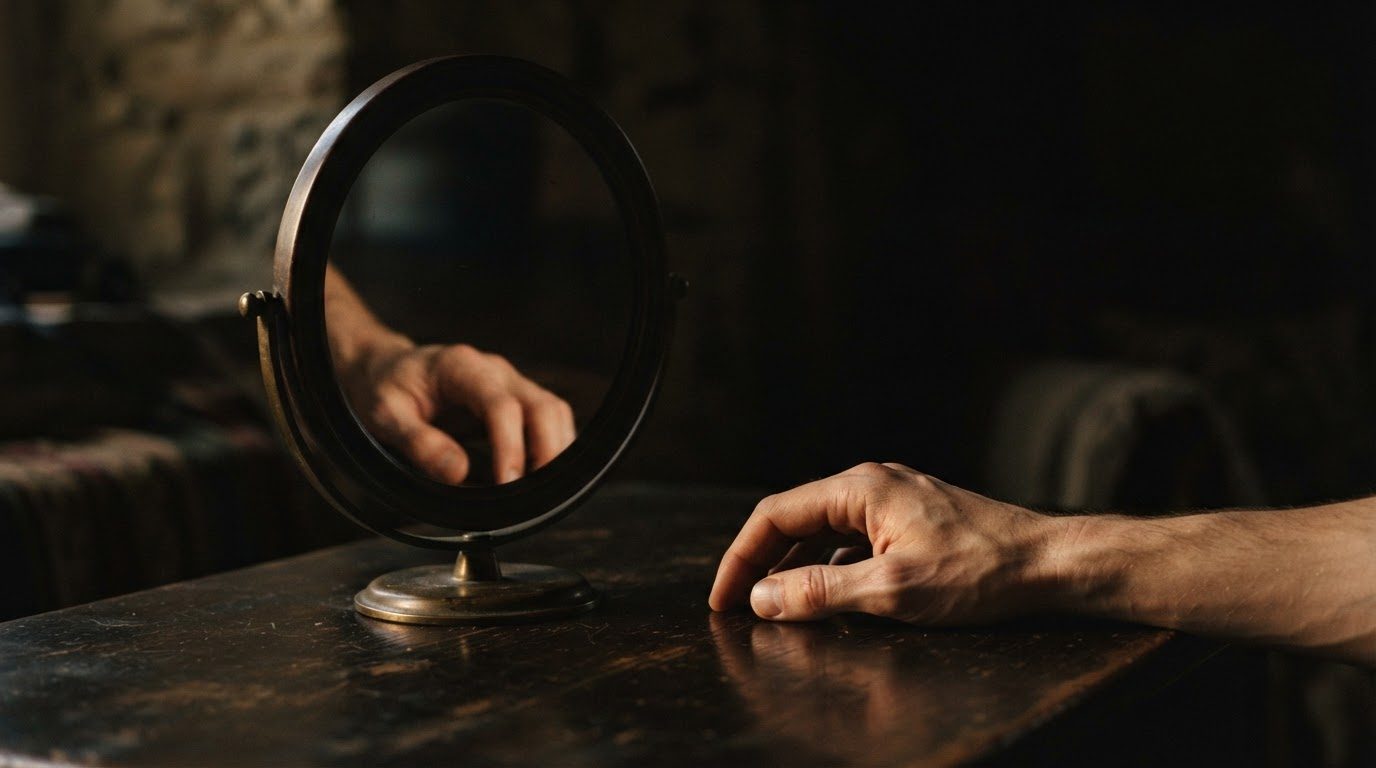
In the 1990s the neuroscientist V. S. Ramachandran devised a simple, low-tech treatment. A patient places their remaining hand into a box with a vertical mirror, so that its reflection appears exactly where the missing hand should be. When they move the real hand while watching the reflection, it can look as though the phantom is moving too. For some patients, watching the phantom unclench appears to relieve the painful clenching sensation. The evidence for mirror therapy is mixed and it does not help everyone, but its occasional success says something remarkable: changing what the brain sees can change what the body feels.
Pain is felt in the body, but it is produced by the brain's reading of the body.
To explain experiences like these, many researchers now describe pain as the brain's conclusion that part of the body is in danger and needs protecting. That conclusion draws on signals from nociceptors, but it also weighs everything else the brain knows: past experience, expectation, attention, mood, context and meaning. In 1965 Ronald Melzack and Patrick Wall proposed their gate control theory, suggesting that signals in the spinal cord could be amplified or dampened before reaching the brain, which is part of why rubbing a knocked elbow genuinely helps. Melzack later expanded this into the idea that the brain contains a neural representation of the body, a neuromatrix, capable of generating the experience of a body even when parts are missing.
Context changes pain in measurable ways. The same heat applied to the skin can be rated as more painful when a person expects it to be severe, and less painful when they are distracted or reassured. Placebo treatments can reduce pain partly by engaging the brain's own pain-relieving systems. Anxiety tends to amplify pain; understanding what is happening can sometimes reduce it. None of this means that pain is imaginary. It means that pain is always real and always constructed at the same time.
This matters beyond philosophy. People with chronic pain have too often been told, explicitly or implicitly, that because no damage can be found, their pain must be in their heads. The science points in a more humane direction. All pain is, in a sense, produced by the brain, including the pain of a broken bone. Pain that persists without ongoing damage is not less real. It reflects a nervous system that has become stuck in a state of protection, and that can sometimes, with the right approaches, be helped out of it.
So where does pain exist? It is felt in the toe. It depends on signals from the toe. But it is produced by the brain, which projects the experience back onto its internal map of the body, placing it where it believes the danger lies. Usually that map is accurate, and the pain appears in the right place. In a phantom limb, the map persists after the territory is gone, and the pain appears in a place that is no longer there.
Perhaps the deepest lesson is that the body we experience is not the same as the body that exists. It is the body as the brain represents it: a living model, constantly updated, used to decide what matters and what needs protecting. Pain is one of the ways that model speaks. It is less a report of damage than a message about what the brain believes must be defended.
The next time you stub your toe, the pain will still be in your toe. It will still hurt just as much. But it may be worth remembering, as it fades, that you are feeling something your brain decided you needed to feel, placed with remarkable precision on a map of a body it is always drawing.