
The Skin Remembers Every Contact With the World
Your largest organ is also a sensing surface, reading pressure, vibration, stretch and warmth in astonishing detail. It may be the sense we trust most to tell us what is real.
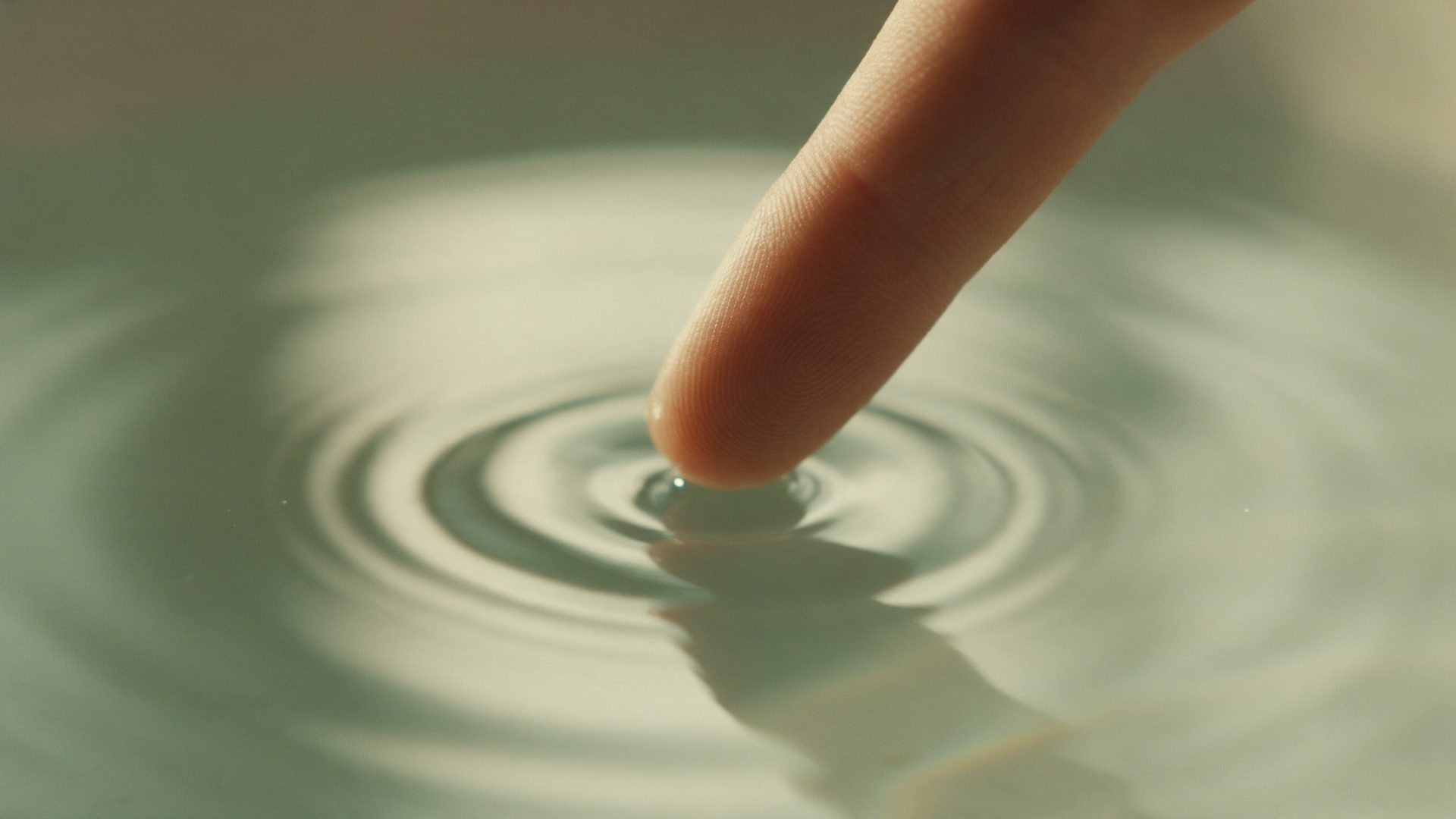
When we doubt whether something is real, we reach out and touch it. A reflection can fool the eye and an echo can fool the ear, but the moment a hand closes around an object, the question seems settled. This is one of the strangest facts about human experience: of all the senses, the one we trust most is the one that works only at the very boundary of the body, where the world presses back against us.
Your skin is the largest organ you have, covering close to two square metres in an adult. It is easy to think of it as a wrapper, a surface that keeps the inside in and the outside out. But it is also a vast sensing sheet, threaded with nerve endings that report continuously on pressure, vibration, stretch, temperature and harm. Most of what it reports never reaches awareness. The weight of your clothes, the chair beneath you and the air moving across your arms are all being measured right now, and almost none of it is being shown to you.
Touch is not a single sense but a collection of them. Buried in the skin are several kinds of specialised receptors, each tuned to a different kind of event. Some respond to steady pressure and fine edges, which is how a fingertip can trace the outline of a key in a dark pocket. Some respond to light, fluttering contact and to the tiny slips that happen when an object begins to slide from your grip. Deeper receptors respond to rapid vibration, the reason you can feel a phone buzzing through a table. Others respond to the skin being stretched, which helps the brain work out the position of your fingers and the pull of whatever you are holding.
Many of these receptors adapt quickly. They fire strongly when something changes and then fall almost silent if nothing changes further. That is why you stop feeling a watch on your wrist a few minutes after putting it on, and why you notice it again the moment it shifts. The skin is less interested in what is there than in what is happening. It is built to detect difference.
This is also why touch depends so heavily on movement. Place a fingertip on a surface and hold it perfectly still, and much of the texture fades. Slide it across the same surface, and the detail returns. As skin moves over a texture, it vibrates in patterns that the receptors translate into roughness, smoothness, softness or grain. The psychologist James Gibson drew attention to this in the 1960s, distinguishing passive touch, where something is pressed against us, from active touch, where we explore. Active touch is far richer. We do not simply receive the world through our hands; we interrogate it.
The precision can be extraordinary. The fingertips carry some of the densest concentrations of touch receptors anywhere in the body, and in laboratory tests people have been able to tell apart surfaces whose ridges differ by only tens of nanometres, far smaller than anything the eye could resolve on the same material. The back, by contrast, is surprisingly blunt. Two points pressed against the fingertip a few millimetres apart feel like two, while on the back they can be several centimetres apart and still feel like one.
The reason lies partly in the brain. Signals from the skin travel through the spinal cord to a strip of cortex called the somatosensory cortex, where the surface of the body is mapped out. The map is wildly distorted. In the 1930s and 1940s the neurosurgeon Wilder Penfield, stimulating the brains of patients during surgery, found that the hands, lips and tongue claim enormous territory while the trunk and legs receive very little. The body as the brain represents it is not the body as it looks in a mirror. It is the body as it is used: shaped by where precision matters.
This internal map is not fixed. It changes with experience. The hand areas of musicians who play stringed instruments can differ measurably from those of people who do not, and after an injury or amputation the neighbouring regions of the map can spread into the area that has gone quiet. The skin may meet the world, but the brain keeps a record of that meeting, and the record is constantly being redrawn.
Not all touch is about information. In the hairy skin of the arms and back there is a class of slow nerve fibres, called C-tactile afferents, that respond best to gentle stroking at roughly the speed of a caress: a few centimetres per second. Faster or slower movement excites them less. Research by the neuroscientist Håkan Olausson and others has found that these fibres send signals towards brain regions involved in emotion and bodily feeling rather than to the regions that analyse shape and texture. Part of the skin seems to be built not for knowing but for comfort. A hand on a shoulder is not telling you anything new about the shape of the world. It is telling you that you are not alone in it.
Touch is also the first sense to develop. A human embryo begins to respond to touch around the lips at roughly eight weeks after conception, long before sight or hearing are functioning. Before we have seen anything or heard anything, we have already been in contact. Perhaps that is one reason touch feels so fundamental: it is the oldest conversation we have with the world.
The brain also uses touch to decide what counts as part of you. You cannot tickle yourself, and the reason is revealing. When you move your own hand, the brain predicts the sensations that movement will cause and turns down its response to them. Research led by Sarah-Jayne Blakemore showed that self-produced touch is felt as weaker than identical touch produced by someone else. The brain is constantly sorting sensations into those it caused and those that came from outside.
That sorting can be fooled. In the rubber hand illusion, first described by Matthew Botvinick and Jonathan Cohen in 1998, a person's real hand is hidden from view while a rubber hand lies in front of them. Both are stroked with brushes at the same time. After a few minutes, many people begin to feel the strokes on the rubber hand, and some report that it feels like their own. When touch and sight agree closely enough, the brain will redraw the boundary of the body to include an object that was never alive.
Touch does not simply report what the body meets. It helps decide where the body ends.
This brings us back to the feeling of reality. Why does touching something make it feel more real than seeing it? One answer is that touch is the only sense that always involves two-way contact. When you see a wall, the wall does nothing to you. When you press your hand against it, the wall pushes back with exactly the force you apply. Touch combines what you do with what the world does in return, and that combination is very hard to fake. A picture of a wall does not resist your hand.
Philosophers have long argued about how much we can know of the world beyond our senses. In the eighteenth century, George Berkeley argued that objects exist only as they are perceived. James Boswell recorded that when he raised the idea with Samuel Johnson, Johnson kicked a large stone and declared, "I refute it thus." It was not a philosophical argument so much as a demonstration of how deep our faith in touch goes. The stone pushed back, and for Johnson that was enough.
Modern neuroscience complicates that confidence without destroying it. Everything you feel through your skin is still a construction, assembled by a brain interpreting electrical signals. The warmth of a hand, the grain of wood and the sting of a cut all exist, as experiences, inside the nervous system. But touch is the construction most tightly bound to consequence. If you misjudge what you see, you may be surprised. If you misjudge what you touch, you may be burned.
So the skin remembers, in its way. It carries calluses where work has pressed on it and scars where it has been broken. Its map in the brain is shaped by every instrument played, every tool held and every hand that has held yours. Each contact leaves something behind, not as a stored image but as a slightly altered way of feeling the next thing you touch.
Reach out now and rest your fingers on the nearest surface. Notice how little you feel while they are still, and how the texture appears as soon as they move. That small act contains the whole story: a sensing surface, a brain building a world from differences, and the quiet confidence that comes from something real pushing back.