
What Darkness Feels Like to an Animal That Does Not Need Sight
For the star-nosed mole, the blind cavefish and the bat, darkness is not an absence. It is simply a world built from something other than light.
For us, darkness means losing the world. Switch off the lights in an unfamiliar room and the space you were standing in a moment ago vanishes. You stumble, reach out, feel for walls, and move with the caution of someone who has suddenly become a stranger in their own surroundings. Human beings are so dependent on vision that we tend to treat darkness as emptiness, as the absence of anything to perceive.
But for a great many animals, darkness is simply where they live. Underground, in deep caves, in murky rivers and in the open air at night, creatures move quickly and confidently through environments that would leave us helpless. They are not coping with a deprived version of our world. They are living in worlds of their own, built from information we barely notice.
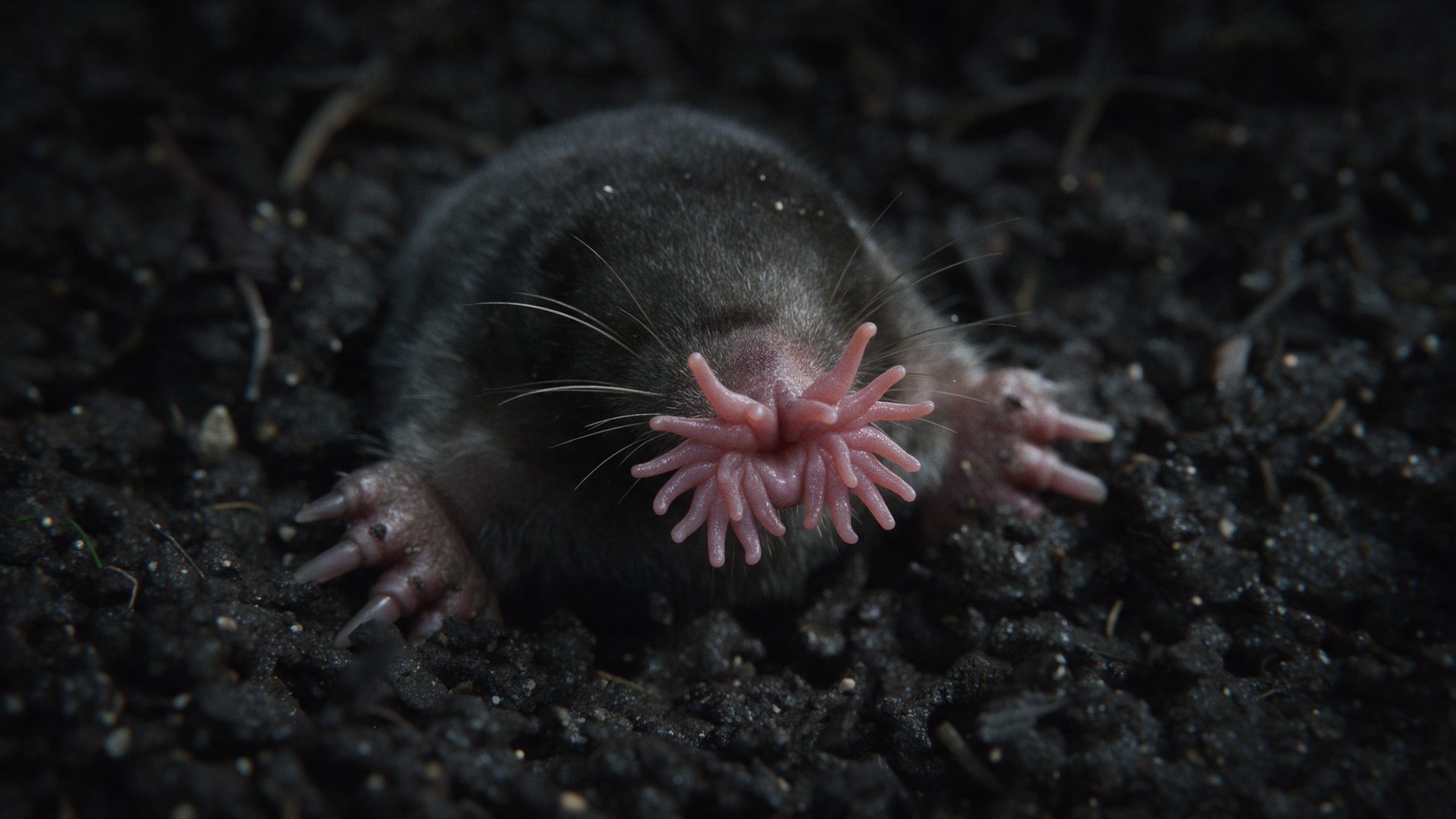
Consider the star-nosed mole of North America. It lives in wet soil and marshland, hunting small invertebrates in tunnels where light is almost useless, and its eyes are tiny. Around its nostrils is one of the strangest structures in the animal kingdom: a ring of twenty-two fleshy appendages, pink and constantly moving. This star is covered in thousands of microscopic touch receptors called Eimer's organs. The neurobiologist Kenneth Catania, who has studied the animal for decades, found that the mole touches its surroundings with the star around ten times a second, and that it can identify and eat a small prey item in well under a third of a second.
In some respects the star behaves like an eye. Catania showed that the mole uses the outer rays to scan broadly and then shifts suspected prey onto the smallest pair of rays at the bottom of the star, which work like a touch equivalent of the fovea, the sharp centre of human vision. A large portion of the mole's brain is devoted to processing signals from the star, with a map of its twenty-two rays laid out in the cortex. The animal does not see the world. It reads it at extraordinary speed through the tip of its nose.
Water offers other possibilities. Almost all fish have a lateral line: a row of pores and canals running along their sides, lined with hair-cell sensors that detect the movement and pressure of the surrounding water. When a fish swims, it creates a flow field around its body, and nearby objects distort that flow. The lateral line senses the distortion. In effect, the fish can feel the shape of its surroundings through the water itself.
Blind Mexican cavefish show how powerful this can be. Their ancestors lived in rivers near the surface, but some populations became trapped in caves and, over many generations, lost their eyes altogether. In the dark, sight had nothing to offer. What they rely on instead is an enhanced lateral line. As they glide along cave walls, they can detect obstacles and changes in the space around them, and studies have found that they build a kind of spatial memory of their surroundings, slowing down and exploring when something in a familiar space has changed.
Darkness is only dark to an animal that expected light.
In the night air, bats have solved the problem with sound. They emit rapid high-pitched calls, most of them above the range of human hearing, and listen to the returning echoes. From the timing, loudness and subtle changes in those echoes, they judge the distance, size, texture and movement of objects around them. As a bat closes in on an insect, it speeds up its calls until they become a rapid buzz, updating its picture of the target many times a second. Some species can detect objects as fine as a human hair in total darkness.
The prey have not stood still. Many moths have evolved ears tuned to the frequencies of bat calls, and they dive or swerve when they hear one approaching. Some tiger moths produce clicks of their own, which in certain species appear to warn bats that they taste unpleasant and in others seem to interfere with the bat's sonar. The night sky is a quiet battlefield of sound that we are almost entirely deaf to.
Other animals use senses we do not have at all. Many sharks and rays can detect the faint electric fields produced by the muscles and nerves of living prey, even when that prey is hidden under sand. The platypus hunts with its eyes, ears and nostrils closed, sweeping its bill through riverbed mud and sensing both the electrical signals and the tiny movements of the animals buried there. Certain African and South American fish generate weak electric fields around their own bodies and sense how nearby objects disturb them, using this to navigate and communicate in water too murky to see through.
What these animals perceive is not a dim or damaged version of our world. It is a world organised around different properties. For the mole, reality is texture, rendered at astonishing resolution. For the cavefish, it is flow and pressure. For the bat, it is echo and delay. For the shark, it includes the electrical signature of a heartbeat. A cave that looks black and empty to us may be full of detail to a fish tracing the currents along its walls.
It is tempting to imagine that these animals experience darkness as a kind of hardship they have learned to overcome. But this may be exactly the wrong way round. We only notice the absence of senses we expect to have. You do not feel the lack of an electric sense, or feel handicapped by being unable to detect Earth's magnetic field as some birds seem to. Those channels of information are simply not part of your world, and so their absence feels like nothing at all.
For a blind cavefish, the absence of light may feel like nothing too. Its world is complete. It is full of edges, currents and obstacles, all perfectly perceptible. The biologist Jakob von Uexküll called the perceptual world of an animal its Umwelt, and argued that every creature lives inside a bubble of experience shaped by its senses. The cavefish and the bat and the star-nosed mole do not live in darkness. They live in their Umwelten, which happen not to be built from light.
This has an uncomfortable implication for us. The human world feels complete too. It feels as though we perceive reality as it is, with nothing important missing. But we are also living inside a bubble, one built largely from a narrow band of light and a limited range of sound. There are fields, frequencies and signals flowing around us right now that we cannot perceive, and their absence feels like nothing.
Perhaps the most humbling thing about animals that live without sight is not what they can do in the dark. It is what they reveal about us. Every creature, including us, mistakes the edges of its own senses for the edges of the world.