
Does Colour Exist Without Someone to See It?
An apple reflects some wavelengths and absorbs others. Whether it is still red when no one is looking is a harder question than it first appears.
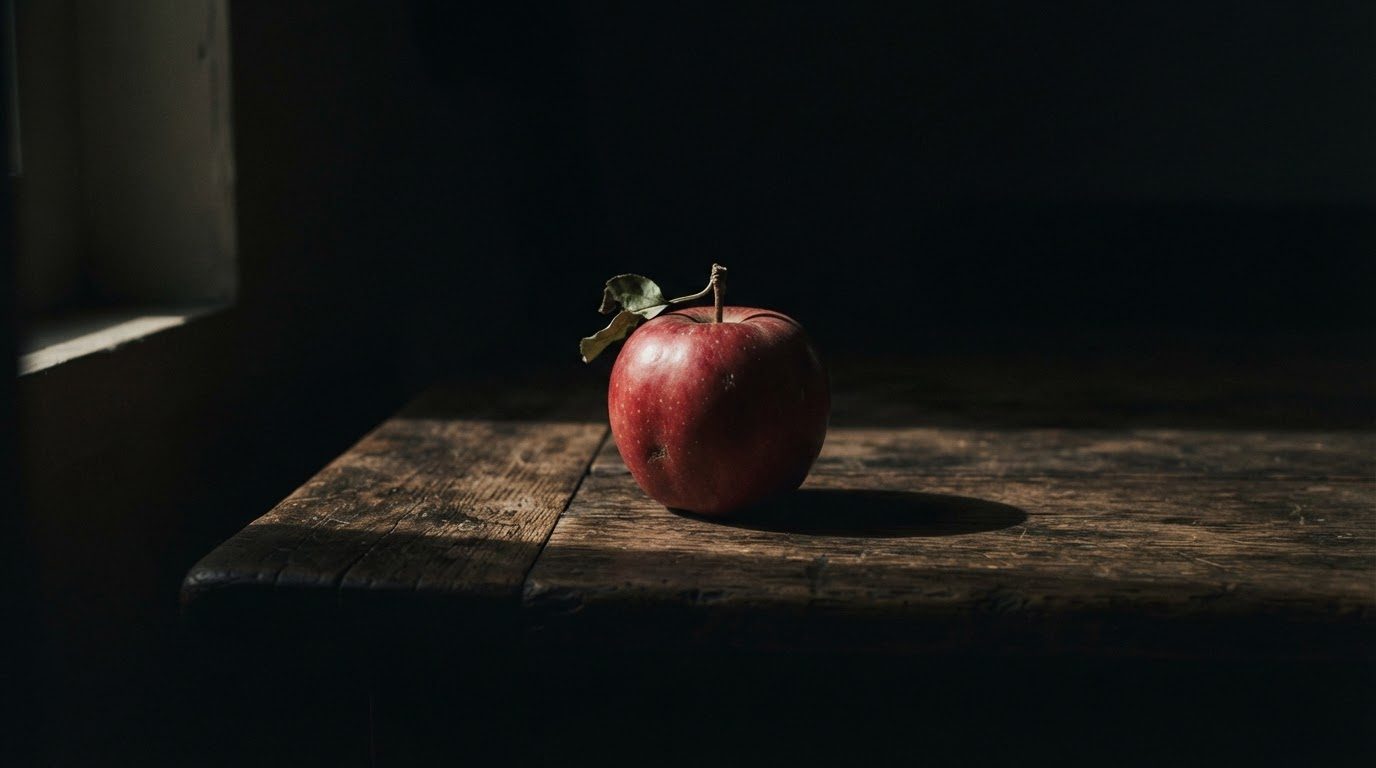
If a tree falls in a forest and no one is around to hear it, does it make a sound? The old puzzle is often treated as a joke, a riddle for late-night conversations. But replace sound with colour and it becomes a serious question that philosophers and scientists still argue about. Is an apple red when no one is looking at it?
Most people's first instinct is that of course it is. The redness seems to belong to the apple, as much a part of it as its weight or its shape. We say the apple is red in exactly the way we say it is round. And yet the more closely we look at what colour actually is, the harder that instinct becomes to defend.
Start with the physics. Light arrives from the Sun or a lamp as a mixture of many wavelengths. When it strikes the surface of an apple, some wavelengths are absorbed and others are reflected. A ripe red apple reflects mostly the longer wavelengths and absorbs much of the rest. That pattern of reflection is a genuine property of the apple's skin, determined by the pigments in it. It remains true in a dark room. It remains true if every creature on Earth closes its eyes.
But notice what has not appeared anywhere in that description: redness. There are wavelengths, measured in nanometres, and there is a surface that reflects some of them more than others. Isaac Newton saw this clearly in the early eighteenth century, writing that the rays of light, strictly speaking, are not coloured. They carry a power to produce the sensation of colour in us, but the colour itself appears only when light meets an eye and a brain.
The idea is older than Newton. In 1623 Galileo argued that tastes, smells and colours reside in consciousness rather than in objects themselves, and that if living creatures were removed, these qualities would vanish. Later in the seventeenth century John Locke gave the distinction its famous form. Primary qualities, such as shape, size, number and motion, belong to objects in themselves. Secondary qualities, such as colour, taste, smell and sound, are powers that objects have to produce particular experiences in us. On this view, the apple has the power to look red, but the redness exists only in the looking.
The world holds the wavelengths. The mind supplies the red.
Modern colour science gives this idea considerable support. The brain works hard to keep colours stable under changing light, a process called colour constancy. A white page looks white in the bluish light of a cloudy morning and in the orange light of a candle, even though the light reaching your eye from it is quite different in each case. The brain estimates the lighting and discounts it. What you see as the colour of an object is not a direct measurement of the light but the brain's interpretation of it.
Sometimes that interpretation divides people. In 2015 a photograph of a striped dress spread around the world because people could not agree on its colour. Some saw it as blue and black; others, just as certainly, saw white and gold. The photograph was the same for everyone. The difference lay in the brain's unconscious assumptions about the lighting. People who assumed the dress was in shadow, lit by bluish daylight, mentally subtracted the blue and saw white and gold. People who assumed it was lit by warm artificial light saw blue and black. The same wavelengths produced two different colours in two different minds.
Some colours do not correspond to any single wavelength at all. Look at a rainbow and you will find red at one end and violet at the other, but no magenta. There is no single wavelength of light that looks magenta. We see it when our eyes receive a mixture of long and short wavelengths, red and blue, with little in between. The brain turns that combination into a colour that does not exist anywhere in the spectrum. Brown is similar: there is no brown light. Brown is what the brain produces when it sees orange or yellow light that is dim compared with its surroundings. These colours are not out there in the light. They are constructions of the visual system.
Does that mean colour is simply an illusion? Not quite, and philosophers continue to defend a range of positions. Some argue that colours are real physical properties of surfaces, identical to their patterns of reflectance, and that our experience is a way of detecting them. Others argue that colours exist only in the mind, projected onto a colourless world. A popular middle position treats colour as relational: it exists in the meeting between a surface, the light falling on it and a perceiver with a particular kind of visual system. Change any one of those three and the colour changes.
The relational view has a certain elegance. It explains why colour feels so firmly attached to objects, since the surface is a genuine part of the relationship. It also explains why colour can vary between observers and why other animals, with different eyes, inhabit different colour worlds. A bird that sees ultraviolet and a person who does not are both in real contact with the same apple. They simply bring different visual systems to the meeting, and so the meeting produces different colours.
What would disappear if every observer vanished? The apple's surface would remain, with all its physical properties intact. The Sun would keep sending light, and the apple would keep absorbing some of it and reflecting the rest. What would be missing is the experience: the particular quality of redness that you know from the inside. That quality, as far as we can tell, has never existed anywhere except in minds.
This is not a lesser kind of reality. Everything you have ever experienced, every colour, sound, scent and texture, has reached you through the same kind of construction. The world is real, and our contact with it is real. But the vivid qualities of that contact are, in an important sense, something that living nervous systems bring into the universe.
Perhaps that is the most interesting answer to the old puzzle. Without anyone to see it, the apple keeps its surface and the light keeps its wavelengths. What disappears is the red as we know it: something that happens only when the world is met by a mind. The universe may not contain colour on its own. It contains the possibility of colour, waiting for an eye.