
Can Another Animal Experience a Colour We Cannot Imagine?
Many birds see ultraviolet. Bees see patterns on flowers invisible to us. Their worlds contain colours that human minds may never be able to picture.
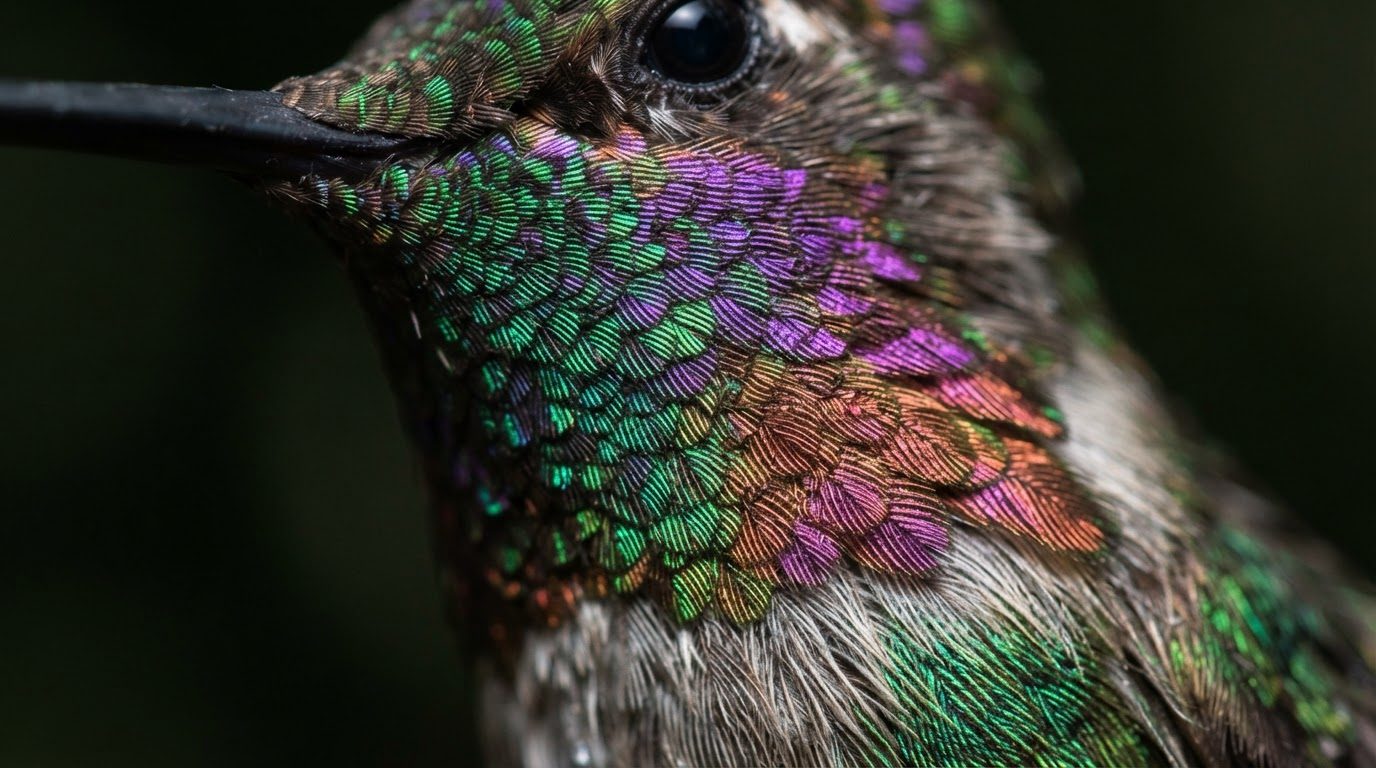
Try to imagine a completely new colour. Not a lighter shade of blue, not a mixture of red and yellow, not a colour you have seen on a screen but forgotten the name of. A genuinely new hue, as different from red and green as they are from each other. Most people who try this find that their mind simply stalls. There is nowhere to go. And yet a great many animals almost certainly see colours of exactly that kind every day.
To understand why, it helps to know how human colour vision works. At the back of each eye, the retina contains light-sensitive cells called cones. Most people have three types, each most sensitive to a different range of wavelengths: roughly short, medium and long, which we loosely associate with blue, green and red. Every colour you have ever seen comes from the brain comparing how strongly those three types respond. A lemon, a sunset and a bruise are all different patterns of activity across just three channels. Our visible range sits between roughly 400 and 700 nanometres, a narrow slice of the wider spectrum of electromagnetic radiation.
Three channels give us a rich world, but a limited one. Colour, for a human, is a three-dimensional space. Every hue we can experience can be located by how much it excites each of the three cone types. A creature with more channels would not simply see more colours within our space. It would have a space with more dimensions, containing whole families of colours that ours has no room for.
Many animals have exactly that. Most birds, many reptiles and many fish have four types of cone, including one sensitive to ultraviolet light. Their colour space is four-dimensional. In 2020 a team led by Mary Caswell Stoddard trained wild broad-tailed hummingbirds in the Rocky Mountains to associate a sugar reward with particular coloured lights. The birds learned to distinguish colours that combined ultraviolet with other wavelengths, such as ultraviolet plus green, from colours that look identical to a human observer. To the hummingbirds these were clearly different colours. To us, one half of the difference simply did not exist.
A bird looking at a meadow is not seeing our meadow with extra detail. It is seeing a different meadow.
Ultraviolet patterns are everywhere in nature once you know to look for them with the right instruments. Many flowers that look plain yellow or white to us carry bold ultraviolet markings, sometimes called nectar guides, that direct insects towards the centre of the flower. The plumage of many birds that appear drab to human eyes reflects ultraviolet strongly, and in some species males and females that look identical to us are clearly different to each other. Bees, which see ultraviolet, blue and green but not red, perceive a combination of yellow and ultraviolet light that researchers sometimes call bee purple, a colour with no human equivalent at all.
The mantis shrimp is often described as the champion of colour vision, and for good reason. These marine crustaceans have twelve or more types of photoreceptor for colour, far more than any other known animal. For years it was assumed they must see an unimaginably rich world of colours. The reality turned out to be more surprising. In 2014 Hanne Thoen and colleagues tested how well mantis shrimp could tell similar colours apart, and found they were worse at it than humans. Rather than comparing signals across channels to perceive fine gradations, the mantis shrimp seems to use its many receptors to recognise colours quickly, almost like reading a barcode. More receptors did not mean more subtle colours. It meant a completely different way of using colour.
Could a human ever see these colours? In a sense, a small number of people come close to the edges. Some women carry genes for a fourth cone type, and in 2010 researchers led by Gabriele Jordan identified at least one woman who appeared to use it, distinguishing colour mixtures that looked identical to typical observers. Such functional tetrachromats appear to be rare, and how different their experience really is remains uncertain. Separately, people whose natural lens has been removed, for example in older forms of cataract surgery, can sometimes perceive near-ultraviolet light, because it is normally the lens that blocks it. They typically describe it as a whitish or violet-blue glow. Even then, what they experience seems to be folded into the colours they already know rather than appearing as something entirely new.
This points to the deepest part of the puzzle. Colour is not in the light. Light has wavelengths; it does not have redness. Redness is what happens when light of certain wavelengths meets a human eye and a human brain. An animal with a different set of receptors and a different brain does not see more of our colours. It has colours of its own, produced by its own nervous system, which may have no counterpart anywhere in ours.
In 1982 the philosopher Frank Jackson proposed a famous thought experiment. Imagine a brilliant scientist named Mary who knows every physical fact about colour vision: every wavelength, every cone response, every neural pathway. But she has lived her entire life in a black-and-white room and has never seen colour. One day she steps outside and sees a red rose. Does she learn something new? Many people feel strongly that she does: she learns what red looks like. If so, then knowing every physical fact is not the same as knowing the experience.
We are all in Mary's position with respect to the hummingbird. We can measure its cones, map its colour space and prove, through careful experiments, that it distinguishes colours we cannot. We can know, with confidence, that its world contains hues outside our own. What we cannot do is step outside our black-and-white room and see them. Philosophers call these qualities of experience qualia, and they are notoriously difficult to compare between minds.
This is not a failure of science. It is a limit built into what any single nervous system can be. Your brain constructs every colour you have ever seen out of three channels of information. It can recombine them endlessly, but it cannot add a fourth dimension by imagining harder. The hummingbird's extra colours are not hidden from you by ignorance. They are hidden by design.
Perhaps that is the most striking thing about colour. We tend to think of the colourful world around us as simply how things are. But every creature that sees is living inside its own palette, built by its own biology. The meadow outside your window is being seen, right now, in ways no human will ever experience: by the bee on the clover, by the bird on the fence, by the insect on the grass. The same light is falling on all of you. It is becoming a different world in each of your minds.