
The Same Sound, Two Different Worlds
The same pressure wave obeys the same laws in air and in water, yet it builds two completely different worlds.
Sound becomes much stranger when you realise that it does not belong to the source that created it. A voice, a drumbeat, a whale call or a clap does not travel through the world as a little object moving from one place to another. What actually travels is a disturbance through matter, and the nature of that matter changes what sound can become.
In air, sound feels ordinary because it is the version we know best. We speak and someone hears us, music fills a room, thunder rolls across the sky and footsteps reveal that someone is approaching from behind. Because air is invisible and constantly around us, we rarely stop to think about the fact that it is carrying physical vibrations from one body to another.
Sound begins when something vibrates and pushes against the particles surrounding it. Those particles compress slightly, then transfer that disturbance to the particles beside them, creating a travelling pressure wave. The individual air molecules do not race from the source all the way to your ear, but the pattern of compression moves through them.
When that same process happens in water, the behaviour changes dramatically. Sound travels through air at roughly 343 metres per second under ordinary conditions, while in seawater it travels at around 1,500 metres per second. The same phenomenon is therefore moving more than four times faster simply because the medium carrying it is different.
Water is much denser than air, but density alone does not explain everything. It is also far less compressible, which means pressure changes can be transmitted through it very efficiently. A disturbance introduced at one point can therefore pass through the surrounding liquid rapidly, allowing sound to become especially important in an environment where vision is often limited.
Humans evolved to hear in air, and our brains are built around that environment. A sound coming from one side reaches one ear slightly earlier than the other and may also be slightly louder on that side. The brain compares these tiny differences and uses them to estimate where the sound came from, often so quickly that we experience direction without noticing any calculation.
Underwater, this becomes more difficult for us. Because sound travels so quickly through water, the difference in arrival time between the two sides of the head becomes smaller, while vibration can also reach the auditory system through tissues and bones in ways that are less familiar to our anatomy. You may therefore hear an underwater sound clearly while struggling to know exactly where it originated.
For marine mammals, this is not a confusing version of the world. It is the world their hearing systems evolved to interpret. The same medium that weakens some of the spatial cues humans depend on can become an incredibly rich source of information for animals whose bodies are adapted to it.
The contrast becomes even more interesting when sound is compared with light. In air, light travels extremely well, which is one reason human civilisation became so visually organised. We can see mountains from great distances, read symbols, navigate using landmarks, build roads around visible structures and fill our environments with signs, screens and images.
Water changes that balance. Light is absorbed and scattered as it travels downward, colours disappear with depth, suspended particles reduce visibility and eventually darkness dominates. Sound, however, can continue travelling through the water long after useful visual information has faded.
The ocean itself also changes how sound moves. Temperature, pressure and salinity affect its speed, which means the path of a sound wave can bend as it passes through different layers of water. Under certain conditions, these changes create regions where sound becomes naturally trapped and guided over extraordinary distances.
One of the best known examples is the SOFAR channel, short for Sound Fixing and Ranging. In this part of the ocean, the changing speed of sound with depth can repeatedly bend certain waves back toward the same region instead of allowing them to escape upward or downward. Low-frequency sound can therefore travel through this natural acoustic corridor over very large distances with relatively little energy loss.
This means the ocean contains invisible pathways that do not resemble roads but perform something surprisingly similar. They are created by temperature, pressure and the physics of wave propagation rather than by concrete or stone. A sound entering one of these pathways can remain detectable far beyond the distance at which a human voice in air would have disappeared.
For whales, this can radically change the meaning of distance. Human beings tend to associate presence with physical closeness, visibility and immediate hearing, so someone kilometres away usually disappears from our direct sensory world unless technology reconnects us. In the ocean, a whale may still receive the voice of another animal that is far beyond visual range.
This suggests that the social geography of a whale may be partly acoustic. Another individual can be absent from sight while still existing inside the listener's sensory world through sound. Distance does not necessarily produce the same kind of separation underwater that it does for humans on land.
Toothed whales such as dolphins and sperm whales take this relationship with sound even further through echolocation. They produce rapid clicks that move through the water, strike objects and return as echoes. From those echoes, the animal can extract information about distance, movement, direction and physical structure.
Humans can understand this mechanism scientifically, but that still does not tell us what the experience itself is like. Imagine standing in a completely dark room, producing a click and immediately knowing from the returning sound where the doorway is, how far away the wall is and whether something ahead of you is moving. Sound would no longer simply be something happening inside space, because it would become one of the ways space itself is revealed.
This is where the difference between air and water becomes more than a lesson in acoustics. In air, sound helped shape speech, music, warning calls and conversation. In water, the same physical phenomenon can become long-distance communication, navigation through darkness and a means of reconstructing the surrounding environment.
The laws of physics have not changed between the two worlds. The medium has changed, and that change alters what the laws are able to produce. The same pressure wave that becomes a fading voice in air can become a travelling signal through kilometres of ocean.
This raises a larger question about how humans understand reality. We tend to treat the behaviour of nature under familiar conditions as though it were the behaviour of nature itself. Sound in air feels normal because air is where our hearing evolved, just as a world organised around light feels natural because human perception depends so heavily on vision.
But nature does not have a preferred version. Air and water are simply different physical environments, and the same underlying laws create different possibilities inside each one. What feels like the ordinary behaviour of sound to us is only one expression of what sound can do.
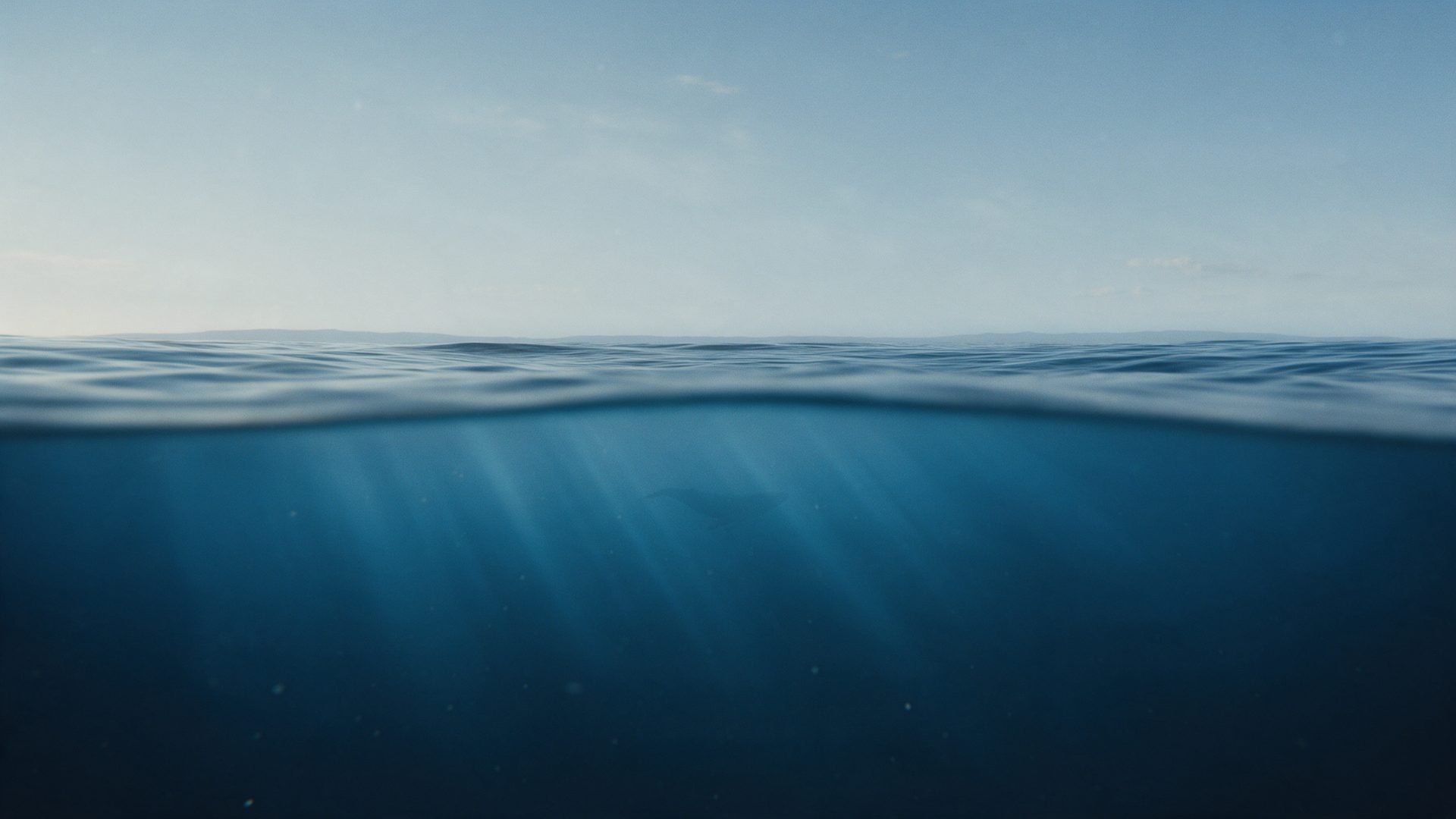
Above the ocean surface, a human voice spreads through air at roughly 343 metres per second and quickly weakens with distance. Beneath that surface, another sound can move through seawater at around 1,500 metres per second, bend through layers of temperature and pressure and reach an animal that may interpret it as identity, direction, distance and structure. Two acoustic worlds can therefore exist only metres apart while operating on remarkably different scales.
Perhaps that is the most interesting part. To humans, sound is usually something that travels through the world and tells us that something happened somewhere nearby. For a whale, sound may be something much closer to a way in which the world itself arrives.